
PNEU-MATE
PNEUmatic Multi-joint Actuation Technologies in Exoskeleltons
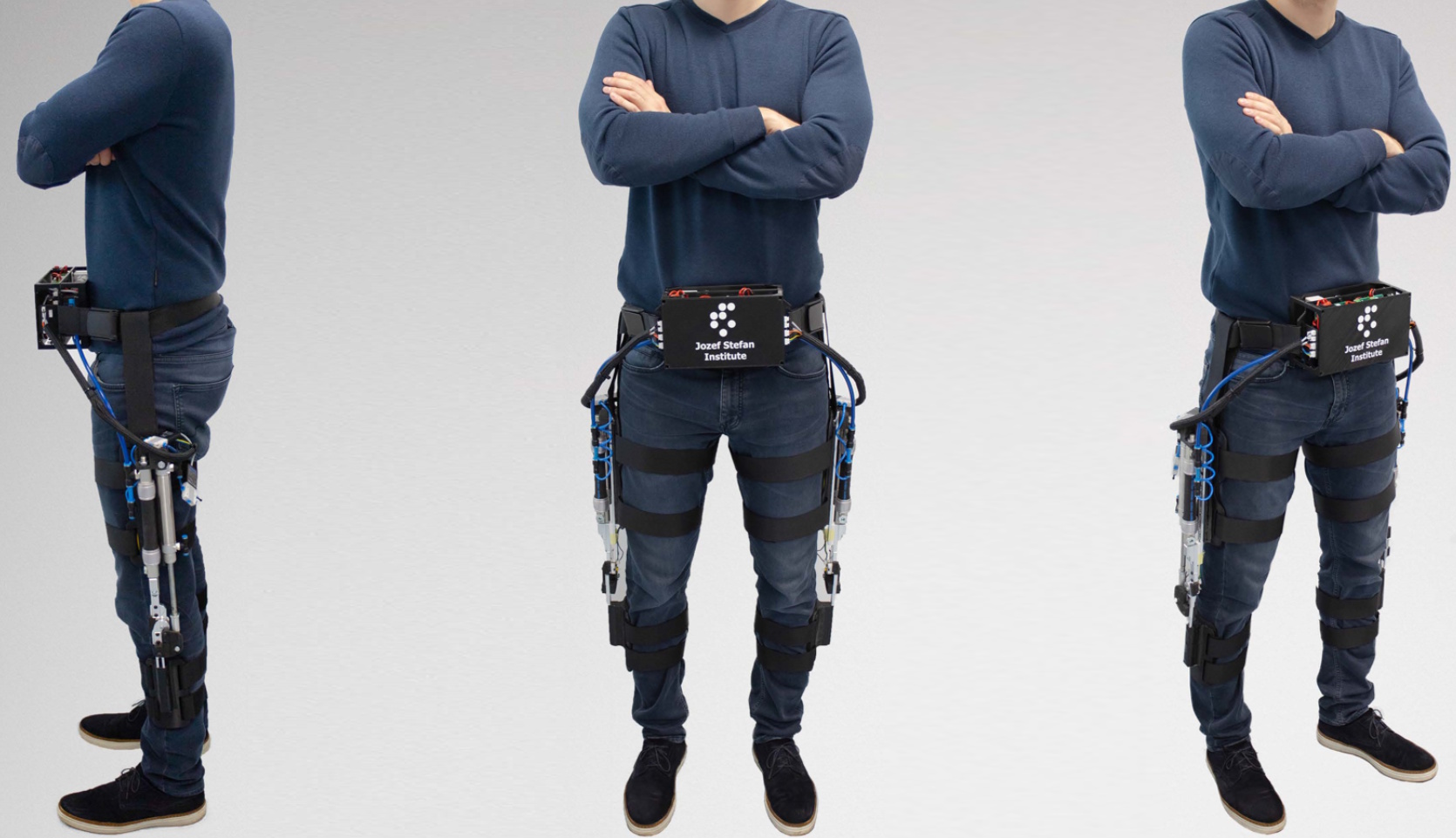
PNEU-MATE is a research project focused on advancing the next generation of wearable robotic systems — exoskeletons — that work in harmony with the natural biomechanics of the human body. The project explores innovative pneumatic actuation technologies that enable efficient storage, transfer, and release of energy across multiple joints, similar to the way biological muscles coordinate movement.
Motivation
Exoskeleton technologies have made significant progress in recent years and are increasingly used in rehabilitation, mobility assistance, and human performance augmentation. However, most current systems are designed to support individual joints independently, such as the knee or ankle. While these designs can provide assistance, they often fail to replicate the natural coordination between joints that characterizes human movement.
In the human body, many muscles span multiple joints and enable energy to flow naturally between them. This bi-articular muscle structure plays a key role in efficient activities such as walking, stair climbing, or jumping. Existing exoskeleton systems rarely exploit this principle, leading to inefficient energy use and limited biomechanical integration.
PNEU-MATE addresses this gap by developing multi-articular exoskeleton systems capable of dynamically transferring energy between joints.
Core Innovation
At the heart of the project is a novel pneumatic actuation mechanism that combines a pneumatic cylinder with a pneumatic artificial muscle. This system can dynamically store elastic energy, modulate stiffness, and release energy when needed, enabling movement assistance that more closely resembles biological muscle behavior.
Unlike many conventional pneumatic systems, the developed actuator is designed to operate without requiring an external compressor, improving portability and making it suitable for wearable robotic applications.
Research Objectives
The project investigates the fundamental principles that enable efficient multi-joint coordination in exoskeleton systems. Its main objectives include:
- Understanding energy transfer across joints in pneumatic multi-articular systems.
- Developing theoretical models and prototypes of exoskeletons connecting the knee and ankle joints.
- Optimizing stiffness modulation to maximize energy efficiency during movement.
- Quantifying joint synergy and energy dynamics during human motion.
Through theoretical modeling, prototype development, and experimental validation, the project will uncover how elastic pneumatic actuators can replicate the cooperative behavior of biological muscles.
Expected Impact
The results of PNEU-MATE will contribute to the development of lighter, more efficient, and more adaptive wearable robotic systems. These advances could have significant impact in several areas:
- Rehabilitation and healthcare, by enabling more natural assistance for people with mobility impairments
- Industrial ergonomics, by reducing physical strain during demanding tasks
- Human performance enhancement, through energy-efficient assistive technologies
By combining advances in robotics, biomechanics, and pneumatic actuation, PNEU-MATE aims to establish the scientific foundations for a new generation of bio-inspired multi-joint exoskeletons
Publications
Invited lectures
Partners

JSI Team
| Members | COBISS ID | Role | Period |
| Petrič Tadej | 30885 | PI | 2026 – |
| Brecelj Tilen | 37467 | Researcher | 2026 – |
| Leon Žlajpah | 03332 | Researcher | 2026 – |
| Jan Šifrer | 58766 | Junior Researcher (MR) | 2026 – |
| Simon Reberšek | 39258 | Technician | 2026 – |
Founding source

ARRS grant no.: J2-70088